
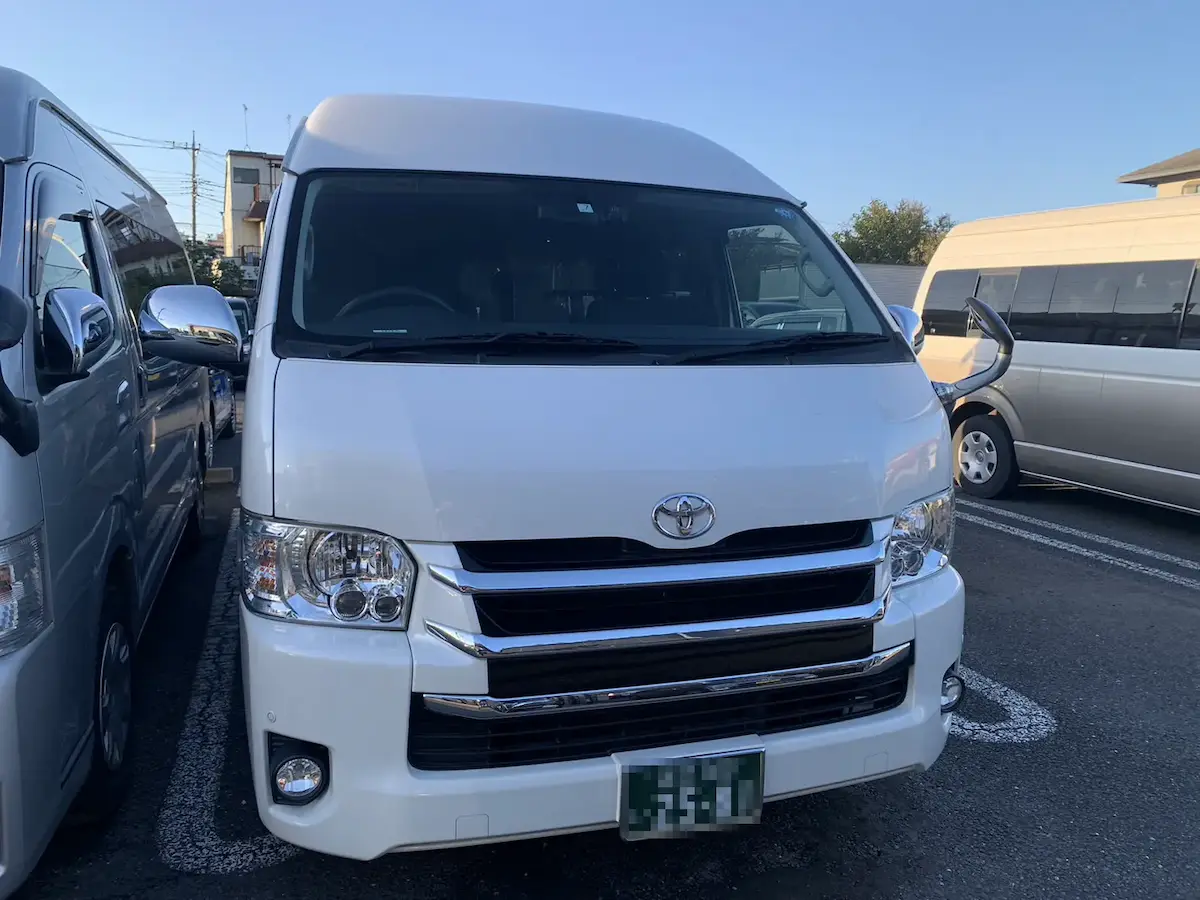
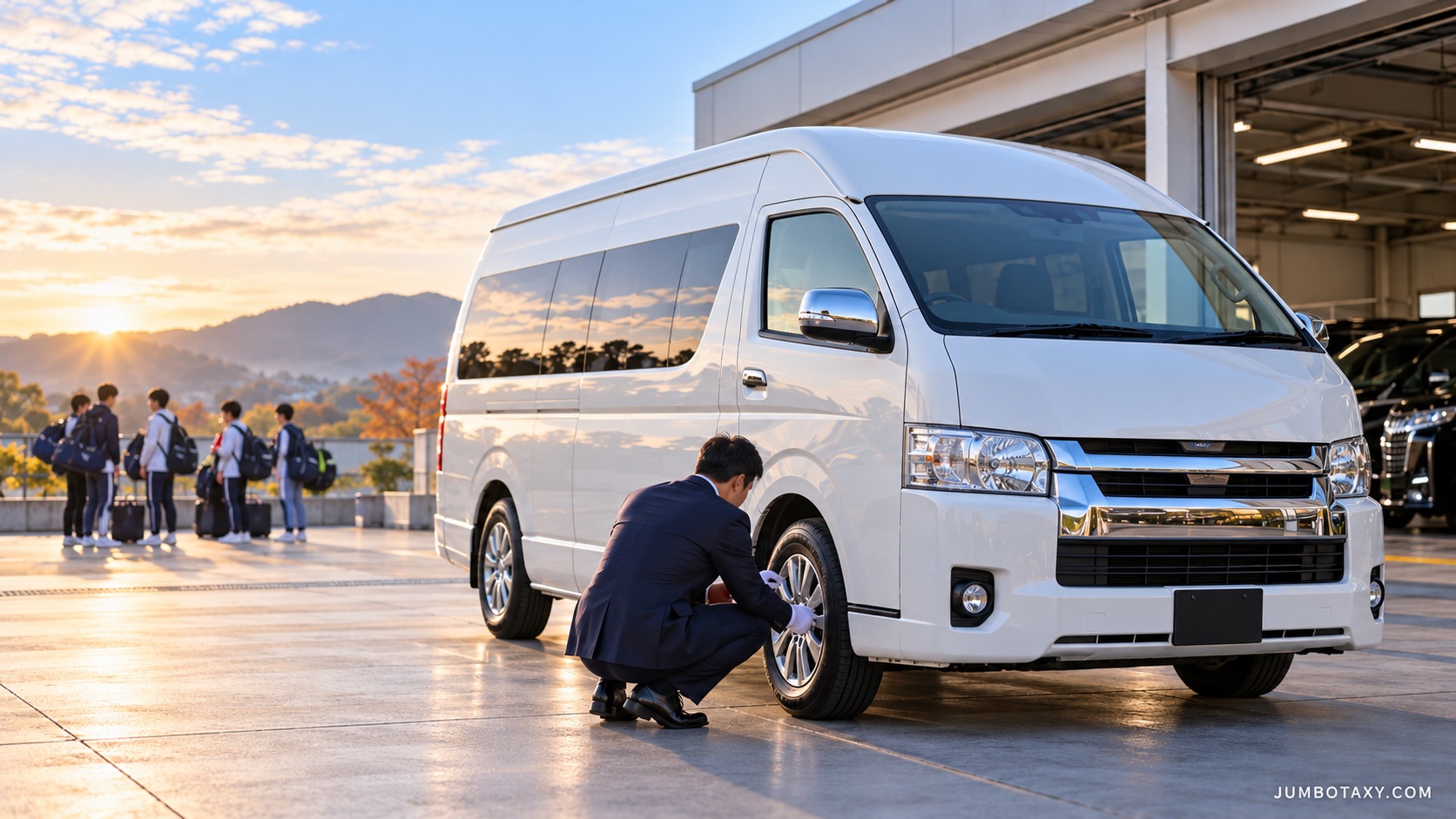
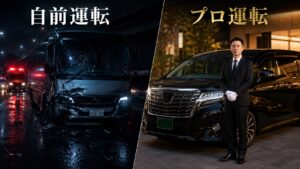
Considering the safety of the transfer
"It's a school trip, so it'll be fine." Do you believe that and send your child off?
Safety in a car depends on the person holding the steering wheel and the system that controls them. Let’s consider the transportation of students on school trips from the perspective of professional dispatch management.
Do you prioritize safety or do you prioritize price?
Early in the morning, a child comes out with a large bag and says, "I'm leaving." It's natural for parents to entrust the school or teachers with the transportation of their children on school sports trips. But in September 2026, another accident involving a minibus carrying high school students heading for a sports trip was reported. The driver was not a professional driver but a school teacher. In this article, from the perspective of a company operating a jumbo taxi service,Transporting participants to and from sports club outingsIn this article, we compare what the differences are between "professional drivers" and "regular drivers," and provide materials for you to consider which of safety and fees you would prioritize.
Another accident happened on the way to a sports team outing
According to reports, the details of the accident are as follows. The cause and circumstances are still under investigation by the police, so we will only summarize the facts reported here.
- Date and time
- September 26, 2026, around 7:50 a.m.
- Location
- Municipal road in Tsuchi City, Mie Prefecture (near the elevated railroad of the JR Namamatsu Line)
- Situation
- A microbus carrying 12 members of the Mie Prefectural High School baseball team collided with a height limit bar just before a 2-meter-high overpass. The bus reportedly has a height of approximately 2.6 meters.
- driver
- A 45-year-old male teacher from the same school (no injuries)
- Damage
- Eight members were transported to the hospital, and six are reported to have suffered serious injuries, including a first-year male member who suffered a spinal fracture.
- Purpose
- The accident happened shortly after the school bus left for a trip to Otsu City in Shiga Prefecture.
We sincerely wish a speedy recovery to all students who have been injured.
In May 2026, a microbus carrying students from a high school in Niigata Prefecture on the Iwate Expressway in Fukushima Prefecture crashed, killing one student. In this accident, a rental car was used instead of a charter bus, and it was reported that the driver did not have a dual license to transport passengers.
This is not just a problem for "one teacher".
Teachers are professionals in education. However, they are not trained or supervised as “drivers” who are entrusted with the lives of many people in large vehicles. In addition to their primary duties of teaching classes and leading club activities, and supervising on holidays, there are aspects of the structure itself that can lead to difficulties. Instead of blaming individuals, we believe it is important to turn our attention to the mechanism of who drives and who oversees those drivers.
Reasons why parents with children have a hard time at heart
Schools are a “place where parents can trust and entrust their children.” That’s why parents are rarely asked to check on things like how much sleep the driver had that morning or how they were feeling. In fact, there’s no way to do that.
For example, imagine a situation like this.
- The day before, I was busy working and preparing until late at night, and the next morning I had to leave early. Does anyone check the driver’s sleep time before departure?
- People who usually only drive passenger cars often drive a large vehicle with a different height and width. Even on familiar roads, have you ever checked in advance whether you can drive this car?
- Is there anyone who, even if the driver has a chronic illness or is taking medication, has the authority to understand that and determine whether they are allowed to drive?
All of these things can happen even without malice or negligence. And for ordinary drivers, most of these checks are left to their own discretion.
Professional drivers and ordinary drivers have such different safety management standards.
Driving licenses come in two types: the "First Class License" for driving private vehicles, and the "Second Class License" for transporting passengers on a fare-paying basis. While anyone with a first class license can basically drive, taxi, chauffeur-driven car, and bus drivers must hold a second class license and work under the country's established operational management system. Let's compare the main differences.
| Comparison items | Professional driver (passenger transport operator) | Ordinary drivers (private use, volunteers, etc.) |
|---|---|---|
| License | Class 2 license. Applicants must be at least 21 years old and have at least 3 years of driving experience (or 19 years old and have at least 1 year of experience after completing the special driving course). This is a skill test that requires the ability to transport passengers. | Class 1 license. I have not taken the exam for passenger transportation. |
| Checks before boarding | Through spot checks by dispatchers and other personnel, the presence of alcohol impairment, health conditions such as illness, fatigue, and lack of sleep are checked and recorded. | Basically, the person's own judgment |
| Alcoholic Beverage Check | Check with an alcohol detector before and after boarding | It is mandatory in some workplaces for vehicles, but it is optional for individuals to drive. |
| health care (e.g. for the aged) | In addition to regular health checkups, the operator will obtain information on the patient's medical history and medication status, and will determine whether the patient is eligible to drive. | It's up to the person. Often, those around them don't even know about the underlying condition. |
| Workstyle | There are national standards for the length of time employees are on duty and the length of rest periods, and these control continuous work and overwork. | It's not uncommon to drive after work or on weekends. |
| Confirmation of fitness | When becoming a new driver or if you are 65 years of age or older and undergo an aptitude test. | Only for renewal procedures |
| Vehicles and routes | Conducts daily and periodic inspections. Checks the route based on the size of the vehicle. | Maintenance and route confirmation depend on the driver or owner. |
Difference 1: The "third party" checks the previous night's sleep and alcohol intake and the person's physical condition on the day of the event
Professional operators always check their drivers before they start their shifts. In addition to checking with alcohol detectors, starting in 2018 they are required to check and record the status of “sleep deprivation” during their shifts. The key is for the operator themselves, not the manager, to check. We are reducing the room for error in this process by implementing a system that prevents drivers from making self-judgments such as “I’m a little sleepy, but it’s okay.”
Difference 2: It not only records the events of that day, but also the patient's medical history.
The cause of an accident is not always just the driver’s physical condition that morning. Professional operators, in accordance with the Health Management Manual of the Ministry of Land, Infrastructure, Transport and Tourism, assess the results of health checks, medical history, and medication status to determine whether to entrust them with driving. The difference between a one-day driver and a regular driver is that they continuously monitor the person’s characteristics.
Difference 3: Unless certain conditions are met, the service will not be provided in the first place.
If a problem is found during the check-in process, the professional driver will not take the wheel that day. They will either appoint a replacement driver or cancel the operation altogether. It’s not because “we have to go today,” but because “the safety conditions are met.” This is the essence of operations management.
When we compare the parents' anxiety with the professional system,
Let me take a look at each of the concerns I mentioned earlier in the context of the operational management system.
Checking for sleep deprivation through point-of-care monitoring
The manager will check before the ride begins and keep a record. There are also standards for rest periods, so there is a system in place to prevent driving after staying up all night.
Check before and after duty with detectors
Instead of relying on self-judgment that "it was only a little last night," I will confirm it with numbers.
The operator understands the patient's history and medication use
Based on health checks and declarations, the operator will decide whether the employee is allowed to work.
Check the vehicle and route in advance
After determining the size of our own vehicle, we will discuss the route and pickup/drop-off locations on the day of the event.
The price includes measures to ensure "safety."
When you hire a professional, of course it costs money. If the parent or teacher drives, the cost might be as little as the gas price. It’s completely natural to feel that the difference is “high.”
However, the professional fee includes not only the labor costs of drivers holding two types of licenses, but also the costs of invisible safety measures such as on-call service by the operations manager, health management, vehicle inspection and maintenance, and insurance for passenger transportation. The fee is the amount calculated after safety measures have been taken.
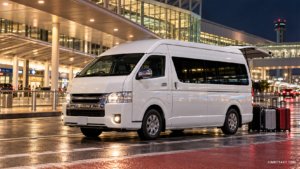
If we think about it in a split-the-bill kind of way:Charter Jumbo taxis can accommodate up to 9 passengers per vehicle (depending on the model). When you divide the cost of a single ride by the number of passengers, you may find that the cost per person is less than you imagined. First, get a quote based on your destination and number of passengers, and then compare it with how much you can afford to spend per person.
Cases where charter jumbo taxis are suitable, and cases where they are not suitable
To be honest, jumbo taxis are not the best choice for all expeditions. If there are 20 or 30 members, it is more reasonable to consult a charter bus operator that operates under the same national permits and management.
On the other hand, in situations like this, the maneuverability of the jumbo taxi comes into play.
- I want a small group of about ten to twenty people to travel to the venue without changing trains.
- There are early morning departures or transfers to venues or training camps that are far from the station.
- Depending on the results of the tournament, the time of return may change, so I would like to have more flexibility in terms of time.
- The teacher wants to get away from driving and focus on watching the students while they are on the move.
In your next team outing, who will be driving and who will be responsible for checking the driver’s sleep and health? Let’s try to think of it in concrete terms for a moment.
5 things you want to check before requesting a transfer
Not only for Jumbo Taxi, when school or parent-teacher associations arrange transportation, it is reassuring to check the following points.
- Are you a licensed passenger carrier (with a green license for business use)?
- Does the driver have a second-class driver's license?
- Is the check-in before boarding (checking for alcohol consumption, health, and sleep) being conducted?
- Are you covered by insurance for passenger transportation?
- Will they suggest a vehicle and number of units that match the number of people and luggage?
The process from inquiry to the day of the expedition
- Contact us via web form:Please provide the date, time, number of people, the amount of luggage, and the destination (venue and accommodation).
- Vehicle type, route, and quote proposal:We will suggest a vehicle that suits the number of people and luggage, as well as a route that is not too demanding.
- Confirmation of reservation:Once you are satisfied with the content, we will proceed with the order. We can also handle requests from both the school and the parent association.
- On-site check-in and departure on the day:The driver who has finished the check-in will pick you up at the school or the meeting point.
Even a consultation would be fine.Inquiries from the web form are available hereIt is.
Should you prioritize safety or price?
A car is a massive piece of metal that can weigh over two tons. Basically anyone with a certain type of license can drive one.
Professional drivers with dual licenses are managed under strict operational control,The service cannot be operated unless certain conditions are met.
The difference is usually invisible to the naked eye.
What we can see is when something happens.
As parents with children of our own, we understand the feelings of parents who believe in schools and send their children there. That’s why we cannot be indifferent to such accidents.
This service includes transportation that only costs gas, as well as measures for safety. I am not going to push you to choose one or the other. But I hope that when choosing a vehicle that carries your precious children, you will compare the “who” and “under what management” factors with the same weight as the “price.” The answer is whether you prioritize safety or price. The answer will be “when something happens.”
Will you review the safety of the next expedition and the transportation?
Simply providing the date, time, number of people, and destination, we will suggest a suggested vehicle type, itinerary, and price. You can contact us 24 hours a day through the web form.
Contact via web formReports and materials to be used as reference
- Report on the microbus accident in Mie Prefecture (Meitetsu TV/Yahoo! News)
- Telegraaf News Related articles
- Report of the accident in which a microbus belonging to a high school baseball team crashed into a viaduct in Tsu City (NHK News)
- Strengthen measures to prevent accidents caused by lack of sleep (Ministry of Land, Infrastructure, Transport and Tourism)
- Review of qualifications for taking second-class driving licenses, etc. (Police Agency)








 日本語
日本語  English
  繁體中文
繁體中文  한국어
한국어