

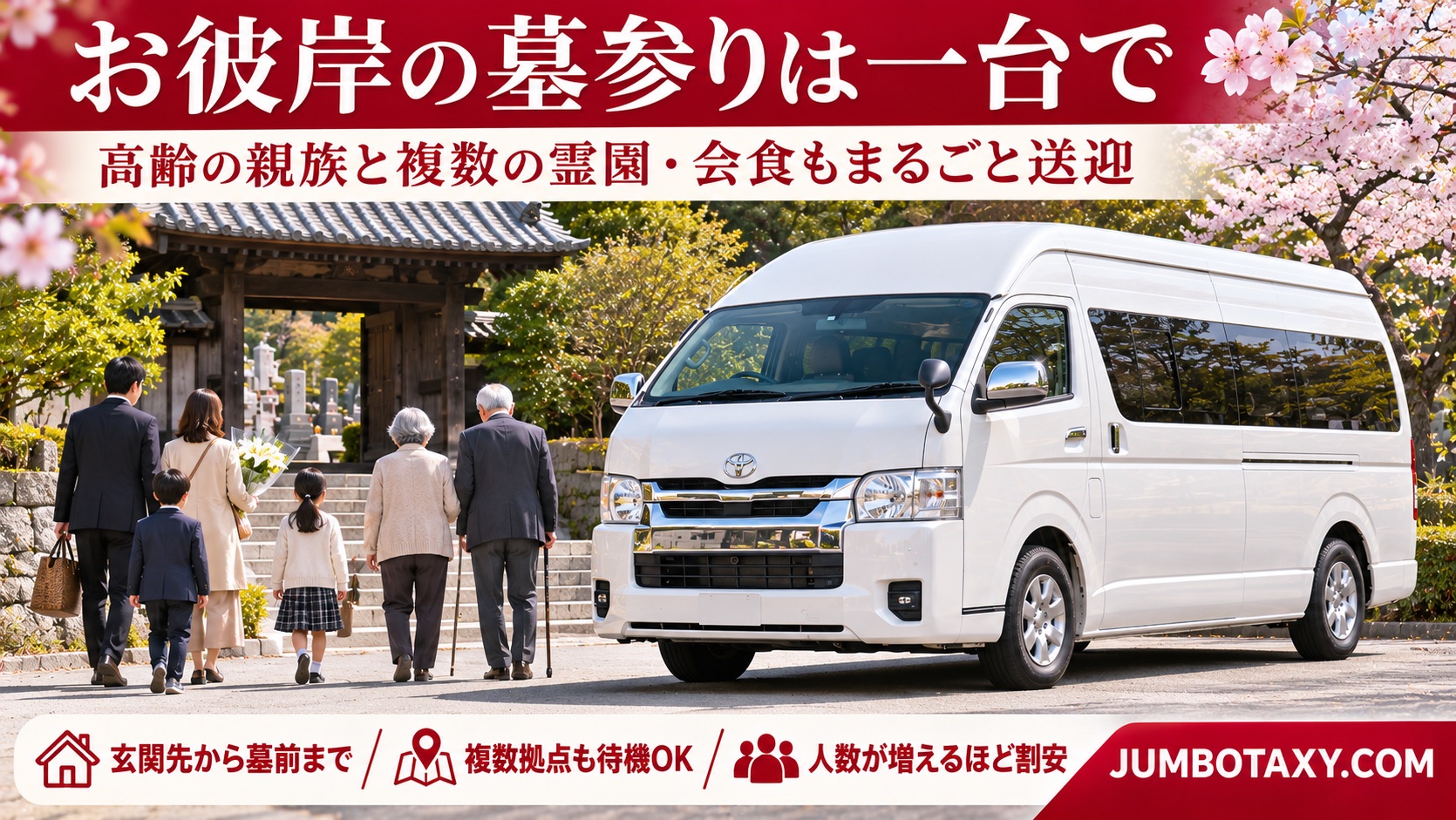
Spring Obon: A visit to the grave with elderly relatives. Even if the temple or cemetery is far from the station, you can have a meal together using just one device.
The Shinto Shokubun (cremation) funeral transportation service is a private jumbo taxi. There are no transfers from the front door to the grave site or the meeting venue, so 4 to 9 people can spend the day together in the same vehicle.
"This year's Shinto festival is the perfect time for everyone in the family to visit the gravesite, even if you have elderly relatives who are feeling weak from illness." However, when you start planning, the journey from the station to the cemetery, and the need to visit two gravesites before having a meal together all become a bit overwhelming. With a private jumbo taxi for Shinto festival grave-sweeping services, you can eliminate many of the hassles and waiting times associated with the trip. In this article, we have compiled common problems, reasons why they can be solved with one vehicle, guidelines for the number of people and the cost, and the Shinto festival schedule and how to get there for spring 2027.
The "common sense" that occurs during spring Ashura when visiting the graves of elderly relatives
The two Shinto holidays in a year are a seasonal event that many families visit their graves at regardless of their religious affiliation. Usually, relatives who live apart gather to pray with their grandparents and parents—it’s a very important day, so you don’t want to tire yourself out from the hassle of the move. First, let’s list the common problems that caregivers and executors often hear from them.
A temple or cemetery that is far from the station; it’s convenient for transfers and walking.
There are not a few suburban cemeteries and ancestral temples that are located in places where you have to take a bus from the nearest station and then walk up a hill. For parents with canes or small children, the “distance from the station” is the biggest burden. By taking the train instead and going up and down the stairs and waiting for the bus to arrive at the right time, you can easily get exhausted before you even get there.
There are two cemeteries, then we had a get-together. It was very difficult to pick up the taxi again.
It’s not uncommon for a day of multiple stops—returning to the main family grave and the branch family grave at different cemeteries, having a gathering with relatives after the visit—to include trips to the taxi service several times. Every time you call the taxi service, there are usually no available taxis in the suburbs, leaving the family split up into two groups. Getting in and out with flowers, incense, offerings, and other items is also a bit of a hassle.
"I want you to wait" is difficult to ask for in ride-sharing apps and vending machines.
During the reading of the Torah and cleaning up before the gravesite, or during a gathering, "I would like you to wait a little." This kind of waiting is something that is difficult to incorporate into ride-sharing apps or taxi stands. When you get off, you often end up having to start all over again on the way back.
Point:Many of the reasons why visiting a grave on Obon becomes difficult are actually due to factors beyond the destination itself: the distance from the station, the need to pick up things along the way, and the difficulty of waiting in line. If this can be done in one go, it will make the day a lot easier.
With that inconvenience, a private charter jumbo taxi can solve the problem completely with just one vehicle.
The charter jumbo taxi (Toyota HiAce Wide Super Long/up to 9 passengers) is a transportation method that takes you from the front door to the grave site, the gathering place, and back home in the same vehicle every step of the way. Let’s replace the previous problems one by one with solutions.
Moving beyond the station → Direct travel from the front entrance to the cemetery
From the front door of your home to the entrance of the cemetery, there is no need to change doors at all. You no longer have to walk the entire distance from the station, bus, or uphill, making it accessible to even those with limited mobility.
Two cemeteries → Tour around them all together
We will take you smoothly from the father's and mother's cemeteries, to the graves of the main and branch families, and to the gathering venue in one vehicle. There is no need to reassemble the belongings; during the journey, all the family members will be in the same vehicle together.
I want you to wait → Because it's a private rental, you can wait
Waiting between chanting the sutras, cleaning up, and having a meal is no problem with a private charter. Once it’s over, you can immediately head to your next destination or home. You won’t have to worry about finding a taxi on the way back.
Flowers, offerings, and offerings → Stored together in the luggage compartment
You can store everything from floral arrangements and incense sticks to offerings and souvenirs for religious ceremonies in a spacious storage compartment. This frees you from the cramped feeling of having to carry everything on your knees.
Trains and rental cars are not to be blamed. A train is sufficient for short distances, and if you have a family that is accustomed to driving, renting a car is also an option. However,I visited several cemeteries far from home, and in one day I even had a meal with my elderly relatives.With that many transfers to make, driving on unfamiliar roads and dealing with the fatigue of splitting up and sharing a ride all at once. “For this one day only, it might be easier to have everyone ride in one car and leave it to someone else.” It’s in situations like these that chartering becomes most effective.
I was chosen for such a day.
Commemoration of the graves of three generations
For three generations—grandparents, parents, and grandchildren—up to 4 to 9 people. Child seat arrangements can also be arranged in advance, so even parents with small children can feel at ease.
Meeting up with relatives from afar
We pick up relatives who have arrived by Shinkansen or at the airport along the way, and then head to the cemetery directly. It is also possible to combine the meeting at the station or airport into one trip.
Visiting a shrine + having a meal + visiting relatives' homes
The standard round-trip tour, where we meet for dinner at a ryotei after the memorial service and then pay my respects at the main house, will also be conducted in the order you specified.
Pricing and guide for the number of people, and the concept of "sharing the bill"
A Jumbo Taxi is a per-car rental fee. The price does not change even if the number of passengers increases, soThe burden per person will be reduced to the point where more people can gather.There are no additional fees based on the vehicle type, nor are there any early morning or late-night surcharge fees. The table below is only a guide to help you think about it; the exact amount will vary depending on the destination, the number of stops, and the length of the wait time.
| Usage Image | Approximate number of people | The concept of sharing the cost |
|---|---|---|
| The parents went back and forth between the nearby cemetery together. | 2 to 4 people | Dividing the charter fee by the number of people, it comes to a feeling of being close to traveling by train and bus per person. |
| Half-day tour of two cemeteries + a dinner gathering | 4 to 6 people | The hassle of picking up the taxi again and again and the cost are combined, making it cheaper the more people there are. |
| All-day touring and waiting with a gathering of relatives | 6 to 9 people | One unit for up to 9 people. This eliminates the need for split seating, making the burden per person even lighter. |
Point:The hassle of switching carriers, the burden of carrying heavy offerings, the fatigue of having to split up with your family—these “difficulties” that are hard to put into monetary terms can be overcome by sharing the costs with others. Accurate estimatesPricing pageやweb formYou can check it out for free here.
When is the Shobun festival in spring 2027? How to assemble a multi-location plan
Onomichi refers to the three days before and after the Spring Equinox and Autumn Equinox, which are counted as the Chuni days (the middle days). Cemetery visits are not limited to the Spring Equinox; you can visit at any time during the Onomichi period.
The date of the Spring Obon festival in 2027
The Spring Equinox in 2027 will be on Sunday, March 21st. The Spring Equinox is as follows: It is busiest on the middle days and the days before and after, and it is relatively relaxed right after the Spring Equinox.
| classification | Date | Guide |
|---|---|---|
| The end of the fast | Thursday, March 18th | The first day of the period. It is relatively empty on weekdays. |
| Chunichi (Spring Equinox Day and Public Holiday) | Sunday, March 21st | The busiest time is usually early in the morning. It is recommended to visit early. |
| After the Fasting Period | Wednesday, March 24th | Last day of the period |
Examples of daily routines (from Tokyo 23 wards and Saitama)
For example, you might leave your home in the morning, visit the first cemetery for prayers and cleaning, then move to the second one in the afternoon to perform the ritual at the grave site, and then head to the gathering place—this is a standard setup. Since cars are waiting for you during your stay at each location, you can adjust the pace of your prayers to your family’s physical condition. Since parking is likely to be crowded on Sunday during Spring Festival, it’s reassuring to plan to complete the first location early in the morning.
Point:If you provide the address of your destination, the order of stops, and an approximate length of stay, we will suggest a route and estimated time for the day that is not too strenuous. We can also arrange for the gathering of relatives at the station or airport.
Reservation Flow
- Contact:From the web form, please provide the date, number of people, your home or cemetery address, the order you would like to attend, and whether you would like to have a meal.
- Plan and Estimate:Based on the route waiting time, we will suggest a suggested price for the vehicle (up to 9 people) and fees.
- Booking Confirmed:Once you are satisfied with the content, it is final. Since Spring Festival is a busy time, early consultation is recommended for peace of mind.
- Boarding on the day:We pick you up at the front door, and we will take you to the cemetery, the banquet venue, and back home in one vehicle.
summary
Spring Ashura is a day filled with the journey from the station to a cemetery that is far from the city center, the need to visit multiple locations, waiting in line, and caring for elderly relatives. With a private jumbo taxi, you can travel from the front door to the grave site and the gathering place in the same car with 4 to 9 people. By eliminating the burden of transportation, you can focus on the time spent together in the car itself. That is the greatest value of renting a private taxi.
Funeral and memorial services and other services involving the transportation of the deceased to the cemetery areAdult-sized funeral transportation by private charter jumbo taxiIt will also be useful for other forms of transportation.Transportation for large groups by jumbo taxi (Comprehensive information on different purposes)Please also see.
For the Shinto Shokubun funeral procession, please consult us all in one go using a single vehicle.
When enough people are gathered, the private charter fee becomes more affordable per person. Leave the hassle of changing trains and the burden of carrying heavy luggage to us.
Simply let us know your desired date, number of people, and destination, and the order in which you would like to travel. You can contact us 24 hours a day through the web form. We offer a free quote.
Contact via web form







 日本語
 English
 繁體中文
 한국어