

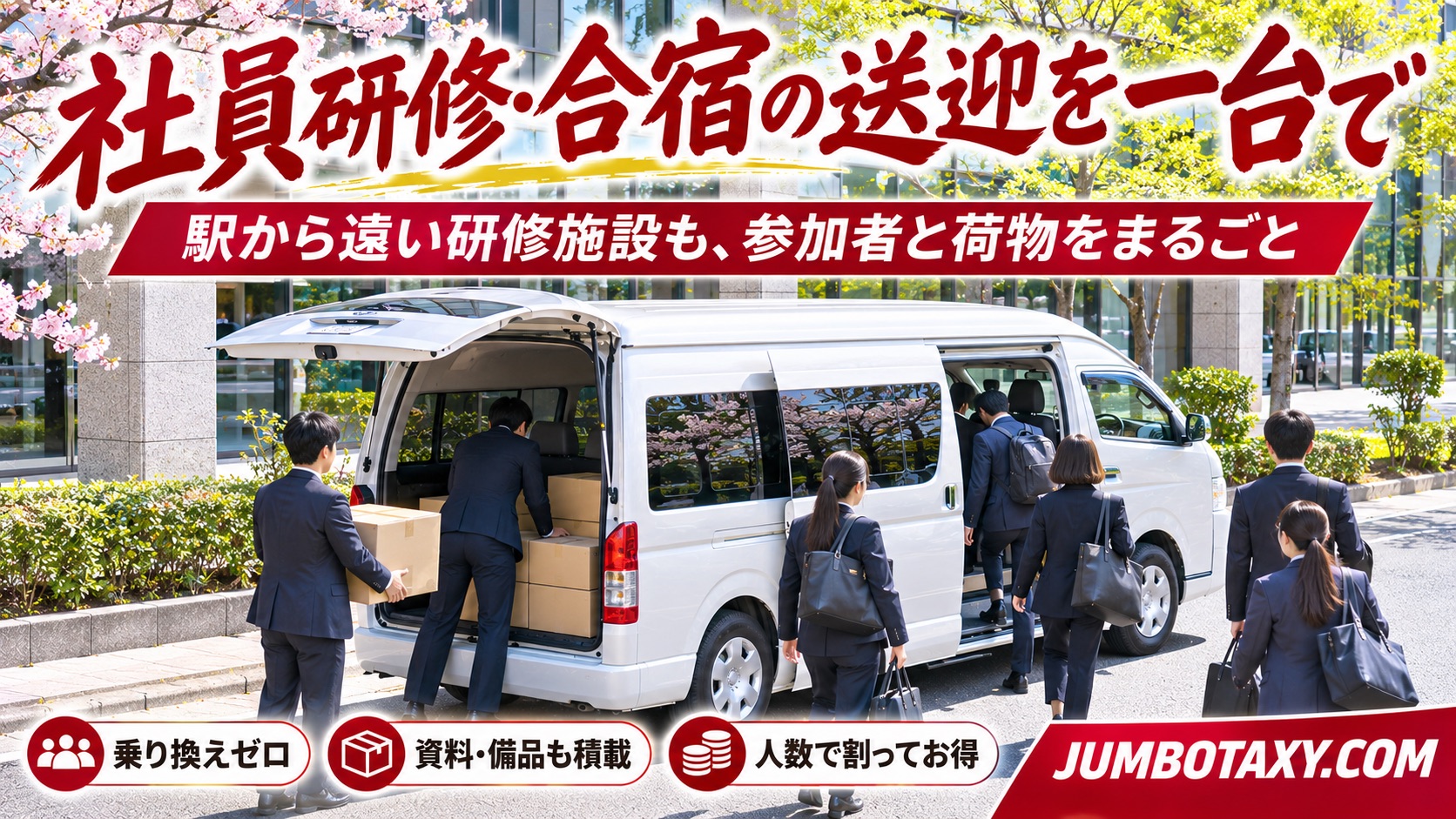
Isn’t commuting to a training facility that’s far from the station a recurring problem every year?
For employee training and camping trips, a private taxi that can carry participants and their materials and equipment together is the quickest way to get there. This makes arranging personnel and general affairs much easier.
As the season for new employee training and senior management meetings approaches, HR and administrative staff often ask, “How about this year’s transportation?” When choosing a private taxi for employee training or management meetings, participants can transport a large amount of materials and equipment from their nearest station to the training facility or hotel all at once. In this article, we’ll check the key points for choosing the right transportation method and how to use it for specific situations such as new employee training or senior management meetings, as well as the preparation from arranging the transportation to the day of the event.
An "everyday thing" that the person in charge of arranging things encounters when transporting employees on company training or camp trips
Even though the actual content of the training is solid, what often causes trouble is how to get everyone to the venue. Especially training facilities and seminar houses often prioritize a quiet environment and are located far from suburban train stations, making transportation a hassle. Do you have any experience with such situations?
Frequently asked questions:"Even more so than taking the bus or taxi from the nearest station," "I don't want new employees getting confused and missing the meeting on time," "The cardboard boxes for training materials, souvenirs, and supplies are heavy," "There are round-trip trips after the second day,"—if these four things are all met, the arrangement becomes much more complicated.
Training facilities are far from the station; arranging for transportation and guidance is a hassle.
Even with a “1-hour journey to the station,” the number of bus departures from there to the facility was limited or the walk was too long. New employees who have just started their jobs have no familiarity with the area, so they might get lost or be late on the way to their next stop. The accompanying staff is often anxious until the day of the event to make sure everyone is there on time. Even if we set the departure time early, everyone is likely to be upset until everyone is gathered.
Interchange on the train, route bus, and carpooling—the slight inconveniences of each
Of course, public transportation also has its advantages. Trains are easy to use when there are fewer people, and the fares are easy to read. However, when it comes to training or camping events, the following burdens become noticeably noticeable. Even when viewed from an impartial perspective, these are points that are difficult to avoid.
| means | Good points | Something that's a bit annoying during training and camps |
|---|---|---|
| Train + Bus | For small groups, it's easy to use and the cost is easy to understand | There are many transfers, and there are few trains from the station to the facility. Moving with a large amount of materials and equipment is heavy work. |
| Carpooling with employees' personal vehicles | With a car, it's door to door | Driver is unable to focus on training; responsibility for accidents and insurance issues; multiple vehicles arrive separately |
| Chartering a microbus | It can carry a large number of people at once | With fewer passengers, it is more expensive; there are limited places to get on and off; and it is difficult to maneuver. |
“The hassle of changing transportation, heavy luggage, fatigue from having to share rides, and arriving at destinations with multiple vehicles at the same time.” These “difficulties that are hard to put into monetary terms” can all be eliminated with the private jumbo taxi that can carry 4 to 9 participants in a single vehicle. Zero transfers are possible from the front door of the training facility to the entrance of the venue, and materials and equipment can be stored in the luggage compartment.
Approximate amount of luggage:The large one-box vehicle (Toyota HiAce Wide Super Long) used in jumbo taxis has the advantage of being able to accommodate up to nine people, plus a compartment for packing together cardboard boxes for suitcases, training materials, and promotional items. If you provide us with the dimensions in advance, we will be able to provide you with a quote for whether or not we can accommodate long-length or special items during the quote process. This saves the hassle of repeatedly confirming the dimensions over the phone, ensuring that both the person and the item fit inside the vehicle.
Checkpoints for choosing a reliable transportation method that won't fail
Before deciding on a strategy, try writing down the following four points. When you can organize these, it will naturally become clear which training program is best for your company.
Number of people and amount of luggage
How much luggage will participants need to bring, such as materials, novelties, and PC equipment? For 4 to 9 people, plus large luggage, a jumbo taxi with plenty of space for seating and luggage can be easily accommodated.
Distance from the station to the facility
The more distant the facility is from the nearest station and the fewer bus services available, the greater the value of door-to-door transportation. If both ends of the journey are within the coverage area, arranging transportation from the station to the training facility will be easier even if it is located far away.
Whether to travel back and forth on a daily basis
Do they offer one-night-two-days, two-night-three-days packages, or do they provide pick-up and drop-off every morning and evening? If you can request the same driver and vehicle every day, the workload for the staff will be significantly reduced.
Ease of forecasting budgets
If there are no additional fees or late-night or early-morning surcharges based on the vehicle type, it will be easier to read the quote. It is also reassuring to check the individual cost per person when calculating the quote based on the number of people.
Used in these types of training sessions and camps, depending on the scene.
Although “training” and “camping” are one and the same, the concerns of the organizers are slightly different. In three typical situations, we will outline how chartering works.
New employee training (April camp-style)
Many companies hold initial onboarding training in the spring in the form of a camp-style event, where they want to bring together new employees who have no previous experience without causing confusion. If a single vehicle can transport them from the office or gathering place to the training facility, all the supervisors can travel together, and the point checks can be done on the vehicle itself. This provides peace of mind for the supervisor, who wants to start the first day with zero confusion and zero tardiness.
Executive Camp and Off-Site Meetings (Year-Round)
Campouts held by executives and management staff at suburban hotels cater to needs year-round, regardless of the season. Many also want to continue meetings while traveling, and private charters are ideal for this purpose, allowing you to keep the conversation flowing without interruption. When you want to welcome guests and executives in a high-quality vehicle:Information on VIP and executive transportPlease also see.
Travels that combine departmental training camps and training trips
If you combine training with social gatherings and site visits, even if you have to stop at multiple locations or wait in between, a charter bus can flexibly accommodate you with just one vehicle. If your main focus is on business travel, our training shuttle service is perfect for that, while your main focus is on socializing, our private transfer service is ideal.Private Jumbo Taxi for Employee TravelThat means that if you use it according to your purpose, the arrangement will be much more organized.
The cost aspect that concerns you should be considered in terms of "sharing the cost".
When people hear the term "chartered," they often have the impression that it's more expensive. However, in the case of traveling with a group for training or camps, the actual situation is more like considering the cost per person rather than the cost per vehicle. The more people there are, the lower the individual cost per person becomes.
Point of view:When you compare it to the “invisible costs” such as train and bus travel expenses, fatigue from sharing rides, and the risk of accidents, it becomes clear that a charter bus that can get everyone to their destination on time with no transfers at all makes perfect sense when the number of passengers is large enough. The exact amount varies depending on the conditions, so please contact us for a quote.Pricing pagePlease check the estimated cost and then request a quote using the web form.
Since there are no additional fees or late or early morning surcharges depending on the vehicle type, even training sessions with early morning start times and late finish times are reassuring because the quote is easy to read. Also, if there are daily pick-ups and drop-offs for one or two nights or two nights and three days, if you can request the same vehicle and driver for consecutive days, there’s no need to start arranging everything from scratch each time, and the contact for the day is also smooth. This gives the staff more time to focus on the actual training operation itself.
Preparation and precautions from arranging the trip to the day of travel
Once the training schedule is finalized, it’s reassuring to consult with the company about the transportation arrangements early on. Especially during April and the start of a new fiscal year, when bookings tend to be concentrated, it’s recommended to make arrangements at least 1 to 3 months in advance.
- Consult via web form:Please contact us with the date of the training, the meeting place, the address of the training facility, the number of participants, the amount of luggage, and whether you will be traveling back and forth on consecutive days.
- Plan and Estimate:We propose vehicles, routes, daily delivery schedules, and pricing guidelines that suit the number of people and the amount of luggage.
- Confirm contents:Confirm the exact meeting time, pickup location, and how to contact the driver on the day of the event to finalize the reservation.
- Boarding on the day:Pick you up at the meeting point, load your materials and equipment into the luggage room, and send you to the training facility door-to-door
Tips for preparation:When it is difficult to find the entrance to the facility or parking locations, it is helpful to share the map or landmarks in advance. If you have long items in your luggage (such as display panels or props), please contact us as soon as possible with the dimensions. We will provide a quote upon request.
summary
Employee training: Shuttle services to training facilities far from the station make it easy for participants and materials/equipment to be transported in one jumbo taxi. For new employee training, it reduces the worry of getting lost or being late, and for executive training, it allows for ongoing meetings while on the move. The cost is calculated based on the number of participants, making it easy to estimate the individual burden. First, organize your training by considering four factors: number of participants, distance, daily travel, and budget.
How to use corporate shuttle services other than training and camp programsTransportation for large groups by jumbo taxi (Comprehensive information on different purposes)Please also see.
For training and camp transportation, let’s start with a quote first.
When all the participants are gathered, the charter fee becomes more affordable per person when paid in cash. We take care of everything else, including the hassle of changing trains and the burden of carrying heavy materials and equipment.
Simply let us know the day of the training, the meeting place, the facility address, the number of participants, and whether you will be traveling back and forth on a daily basis. You can contact us 24 hours a day through the web form; our quote is free.
Contact via web form







 日本語
 English
 繁體中文
 한국어