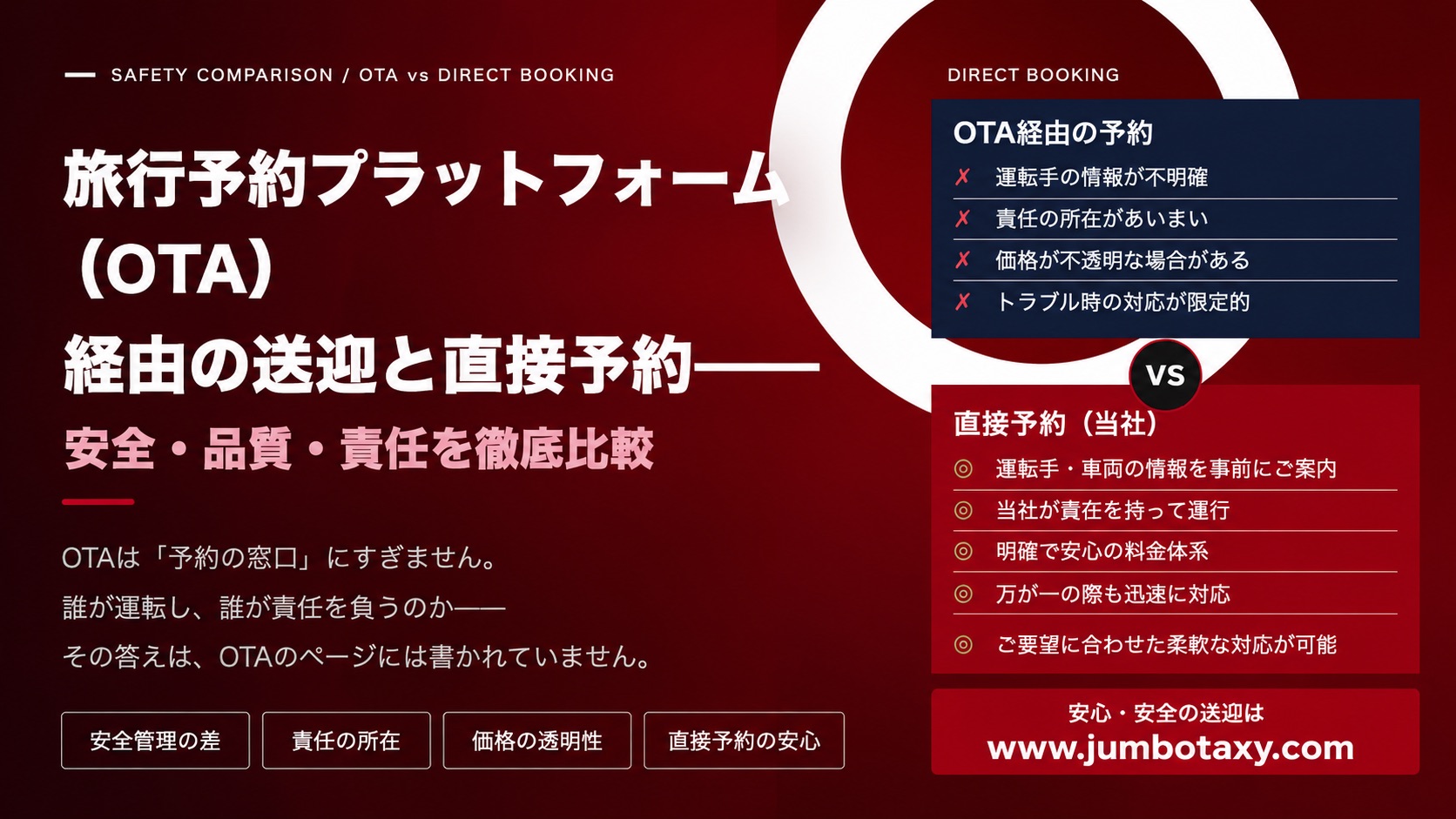
transfers via travel booking platforms (OTAs) and
Direct booking--.
Which one are you?
Do you trust them with your life?
The OTA is only a 'booking window'. Who drives and who is responsible - the answer is not written on the OTA's page.
'I booked my airport transfer on a travel booking platform (OTA)' - the use of OTAs to book transfers is spreading among travellers. The prices are easy to see, can be completed on a smartphone and reviews can be checked. It is certainly convenient. However.OTAs are 'booking intermediary platforms' and do not have the ability to guarantee the safety management standards of the actual operators.This article visualises the difference between transfers via OTAs and direct bookings with MLIT-approved operators from all angles.
CHAPTER 01. What is OTA - how it works and the 'limitations' that travellers do not know about.
The OTA is the 'booking contact' and not the 'person responsible for transport'.
OTA (Online Travel Agency) is the generic name for online platforms that allow users to search and book hotels, tours and transfers in one place. A large number of services, whether Asian, Western or domestic, are available worldwide.
These services provide'Booking intermediaries'.It is. It is the myriad 'member operators' registered with the OTAs that actually drive the vehicles, not the OTAs themselves. This structure creates a decisive problem in terms of safety.
Travel booking platform
Unclear who will be driving.
Ministry of Land, Infrastructure, Transport and Tourism-approved and green number operator
The structure behind 'look cheap'.
One of the reasons why transfers via OTAs appear cheaper is,Structure whereby registered operators pay a fee (around 15-301 TP3T) to OTAs.It is in the The cost of this will always be passed on somewhere else. The most likely to be cut are - investments in safety. Frequency of vehicle maintenance, driver training, insurance coverage - these are not visible in the price.
- A vehicle arrives that is different from the type and capacity of the vehicle reserved.
- Drivers do not speak Japanese and cannot communicate
- The correspondence is passed back and forth between the OTA and the supplier when cancellations or changes are made.
- In the event of an accident, OTAs claim immunity and compensation negotiations are difficult.
- Even if there are many reviews, the actual contractors and drivers in charge may differ
CHAPTER 02. Via OTAs vs direct booking - safety, quality and responsibility compared across the board
Visualising differences in all perspectives
Comparative conclusion - OTAs sell 'convenience' but not 'safety'.
OTAs are an excellent tool for the easy purchase of travel experiences. However, OTAs do not have the ability to guarantee "who will be driving" or "whether the operator meets the MLIT standards". For transfers involving your loved ones, the only answer is to ask the operator who has that guarantee directly.
CHAPTER 03. OTAs cannot guarantee 'safe transport', structural reasons
The business model of the platform is incompatible with safety management.
The OTA business model is based on 'registering more suppliers and providing more choice to travellers'. This is because increasing the number of registered suppliers is a revenue driver,Rigorous review and oversight of the safety management standards of each contractor is unlikely to be a business priority.Structure.
'Good word of mouth = safe' does not hold.
OTA reviews rate 'satisfaction with the experience'. If the driver is pleasant and arrives on time, this is rated highly. However.Whether the driver was alcohol tested before departure, had a medical examination, or had a clean driving record - these are not reflected in any reviews.
CHAPTER 04. Choose direct booking over OTA - five situations.
The more 'important the move', the more direct booking is recommended.
Group transfers for weddings, funerals and legal events
Moving problems on the day of an important ceremony cannot be undone. Instead of relying on OTA word-of-mouth to choose a supplier, you can be sure that you are dealing directly with a business that has clear responsibilities and will be able to respond to you in the event of a problem.
Airport and train station transfers in time for flights and bullet trains
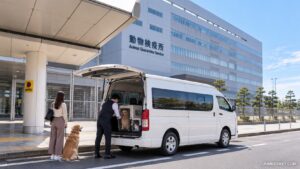
When problems occur via OTAs, it can take time to contact the international support centre, during which time you may miss your flight. With direct booking, the operator can be contacted immediately in case of an emergency.
Transport with children, elderly and people with disabilities
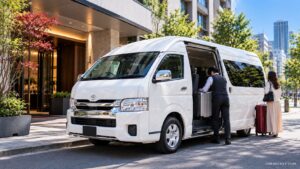
For journeys that require special consideration, such as child seat support, wheelchair space or assistance with getting in and out of the vehicle, it is safer to book directly, where you can discuss your requirements in detail in advance, which cannot be communicated using the standard OTA form.
Company and corporate transport, inspection and training transfers
It is difficult for OTAs to deal with corporate contracts, receipts and managing multiple dates, which are necessary for business use. In addition, in the event of an accident involving the company's credibility, it is essential to contract directly with a licensed operator with a clear insurance and indemnity structure.
Travelling complex routes with multiple stops
In most cases, complex itineraries such as 'Point A -> ceremony venue -> hotel -> airport' cannot be handled by OTA's standardised plans. By consulting with them directly, they can suggest the most suitable route and price.
CHAPTER 05. Why JumboTaxi.com insists on 'direct booking'
Not via OTAs - a proof of security in itself.
Jumbotaxy.comdoes not register with OTAs and takes all bookings directly with the customer. The reasons for this are clear.The moment it goes through OTAs, transparency and responsibility for safety management is blurred.From.JUMBOTAXY.COM operates all its own operations and does not sub-contract its operations.
- Licensed operators with a passenger transport permit (green number) from the Ministry of Land, Infrastructure, Transport and Tourism.
- Driving records (driving record certificates) of all drivers are checked at the time of recruitment.
- Roll call and alcohol test for each departure conducted and recorded by the operation manager
- Regular medical check-ups at least twice a year and aptitude tests approved by the Ministry of Land, Infrastructure, Transport and Tourism for all employees.
- Full passenger personal and voluntary insurance. Operator is liable in the event of an accident.
- Direct support in Japanese. Flexible support for flight delays and sudden changes.
The peace of mind of direct booking, not through OTAs.
To a business that is MLIT-approved, professional driver and fully insured - all of which can be checked directly.
Wedding, funeral, airport transfers, sightseeing and corporate transfers, nationwide.